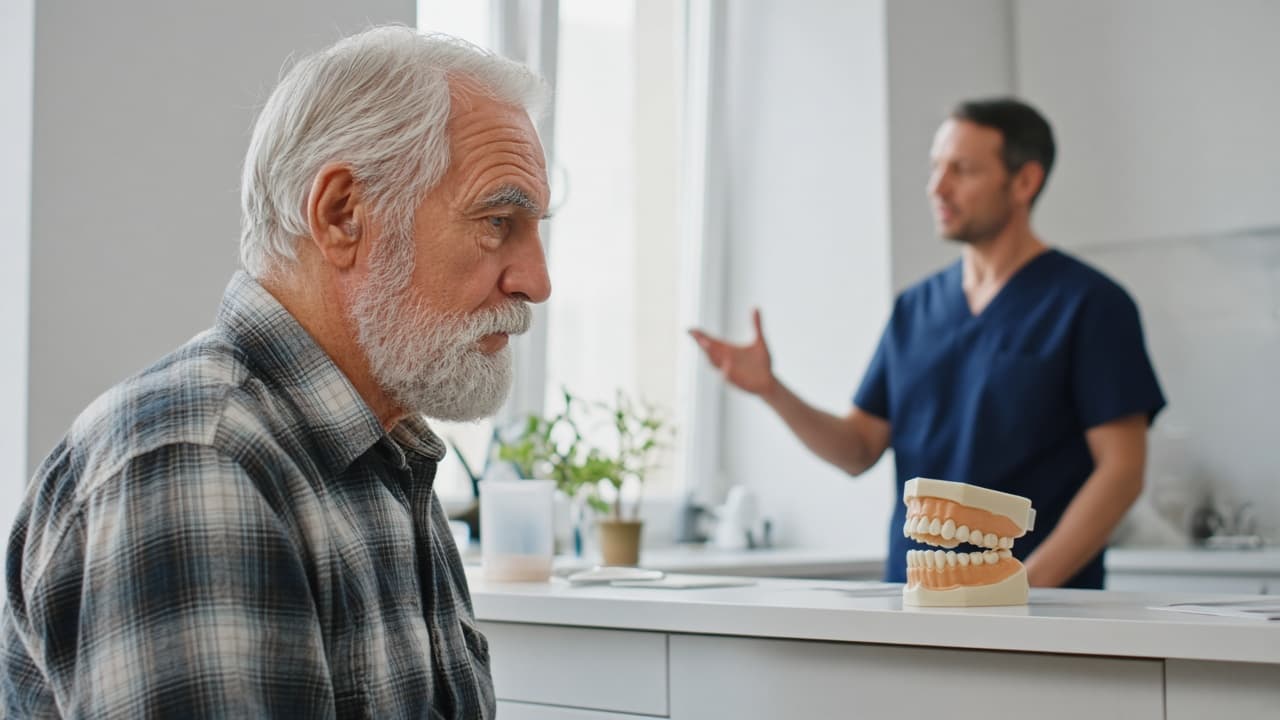
Key takeaways
- A 2003 mandibular series attached a provisional acrylic bridge within two hours. That timing belongs to that protocol.
- Published papers do not give a personal day-by-day pain, swelling, or diet calendar.
- Ordinary soreness is not the same as peri-implant disease.
- If something feels wrong after treatment, call the clinic. The quiz is for planning, not for a problem in progress.
| Reported in that study | Not reported as your timeline |
|---|---|
| 44 patients, 176 immediately loaded implants, completely edentulous mandibles | A personal forecast |
| Provisional fixed acrylic prosthesis within 2 hours | A promise that every visit ends that way |
| 5 of those implants lost before 6 months | A day-by-day pain, swelling, or diet chart |
| Cumulative implant survival 96.7% and 98.2% in the two groups; prosthesis survival 100% | How many days you should take off work |
Not sure which option fits your mouth? Nine questions, no obligation, and a personalized next step.
See if a fixed bridge is the questionWhat did the original study actually time?
Maló, Rangert, and Nobre studied immediate function within two hours using four Brånemark implants to support fixed prostheses in completely edentulous mandibles. Forty-four patients received 176 immediately loaded implants and fixed complete-arch mandibular prostheses in acrylic. Five immediately loaded implants were lost before six months. Cumulative survival was 96.7 percent in the development group and 98.2 percent in the routine group. Prosthesis survival was 100 percent.[1]
Those rates belong to that retrospective mandibular series. They are not a description of the upper jaw, and they are not a script for the first weeks at home. This page does not copy the study's medication regimen into patient advice.
Same-day teeth, as a separate question, are discussed in same-day dental implants. The clinic's visit sequence is on what to expect.
What should you not treat as a schedule?
The papers used here do not establish when swelling peaks, which foods are allowed on which day, or how many days of work you should book off. If a clinic gives you written aftercare, that sheet is the instruction for your case. This article will not invent a substitute.
Long-term complication rates from later follow-up, including mechanical problems years on, are not "the first weeks." How long the implants were still present in a later mandibular series is covered in how long All-on-4 implants last.
Why call if it does not feel ordinary?
The 2017 World Workshop separates peri-implant health from disease. Health is the absence of redness, bleeding on probing, swelling, and suppuration. Peri-implantitis adds progressive bone loss, with bleeding or pus, deeper pockets or recession, and bone loss on a radiograph. Diagnosis needs a clinician.[2]
That is not a home test you can finish from soreness alone. If you already have an implant and it does not feel right, use what to do next and call the clinic at 613-841-6111. The quiz on this page is for people still choosing a treatment, not for someone who needs a clinician today.
Tom Szarski, DD, is the denturist. The implant surgeon places the implants. Recovery questions after surgery go to the team that treated you.
Sources
- "All-on-Four" immediate-function concept with Brånemark System implants for completely edentulous mandibles: a retrospective clinical study — Clinical Implant Dentistry and Related Research
- Peri-implant diseases and conditions: Consensus report of workgroup 4 of the 2017 World Workshop — Journal of Clinical Periodontology
Frequently asked questions
Will I leave with teeth the same day?
In the 2003 Maló mandibular series, a provisional fixed acrylic prosthesis was attached within two hours. That is what that study did. It is not a schedule this page can assign to every person.
How long will swelling and soreness last?
The studies cited here do not publish a personal day-by-day pain or swelling calendar, a time off work, or a diet schedule. Ask the clinic for the instructions that match your surgery.
When is discomfort a reason to call?
Peri-implant disease is a clinical diagnosis: bleeding on probing, swelling, suppuration, deeper pockets or recession, and radiographic bone loss. Those signs are not the same as ordinary post-operative soreness. If a treated implant does not feel right, call the clinic.