Key takeaways
- After extraction, the jaw ridge loses more width than height in the first months.
- Tan and colleagues reported mean buccal losses of 3.79 mm horizontally and 1.24 mm vertically at six months.
- The All-on-4 concept was described as a way to use remnant bone and avoid regenerative procedures.
- That review also says the evidence is limited. A 3D scan is still required.
Human re-entry studies found the ridge changes quickly. At six months, mean buccal horizontal reduction was 3.79 mm and mean buccal vertical reduction was 1.24 mm. Mesial and distal vertical means were 0.84 mm and 0.80 mm.[1]
| Finding | Source limit |
|---|---|
| Horizontal loss 29–63% and vertical loss 11–22% by about six months | Pooled human re-entry studies, not one patient's X-ray |
| Fastest change in the first 3–6 months | The review describes the pattern after extraction |
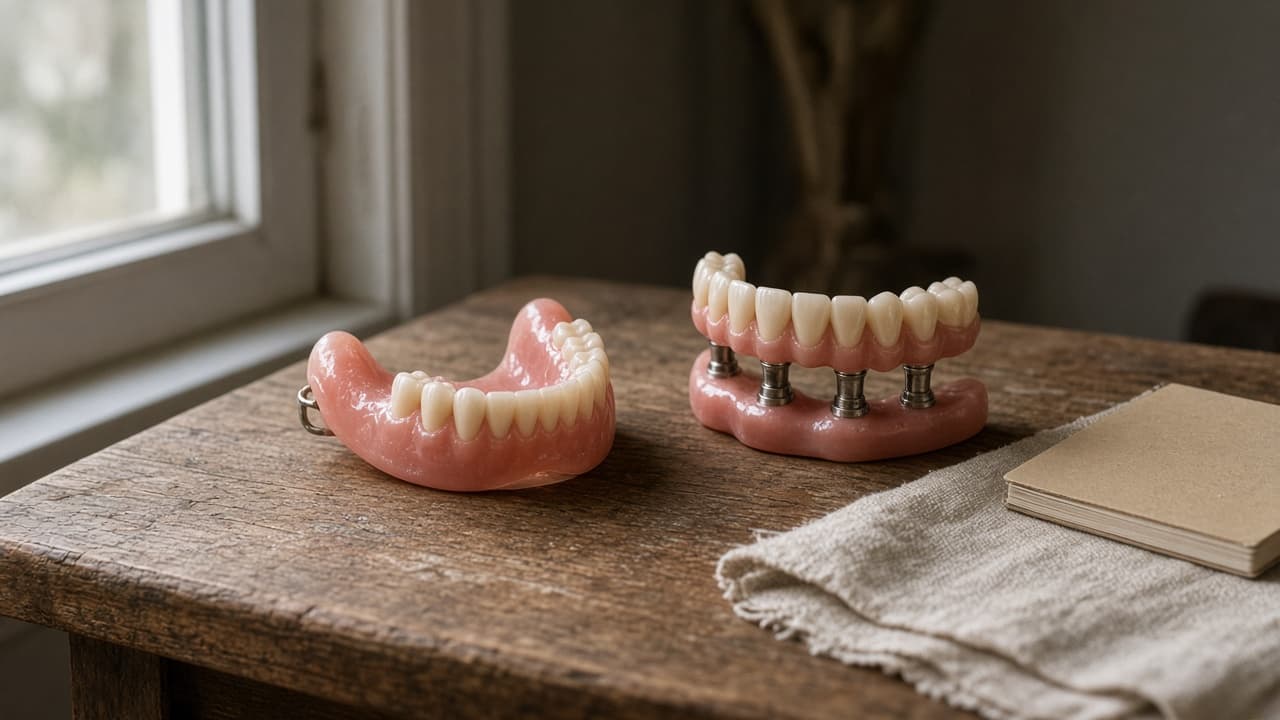
| All-on-4 uses four anterior implants, two of them angled, and a provisional fixed prosthesis | Described as a concept for atrophic jaws. The review says the evidence is limited |
Not sure which option fits your mouth? Nine questions, no obligation, and a personalized next step.
Start with the implant candidate quizHow much bone changes after teeth are lost?
The bone that held a tooth loses the load of chewing. Tan, Wong, Wong, and Lang reviewed human studies that re-entered extraction sites. They reported horizontal bone loss of 29 to 63 percent and vertical bone loss of 11 to 22 percent after six months, with rapid reductions in the first three to six months. Horizontal percentage loss was about 32 percent at three months.[1]
Those are study means. They are not a measurement of your jaw. People who have been without teeth for years are the subject of All-on-4 after years of missing teeth. Diabetes and smoking, which are separate from bone volume, are in dental implants with diabetes or smoking.

What was All-on-4 designed to do in a thin jaw?
Soto-Peñaloza and colleagues describe the concept as a way to maximize remnant bone in atrophic jaws, to provide immediate function, and to avoid regenerative procedures. The protocol they summarize places four implants in the anterior jaw, two axial and two angled posteriorly, to shorten the cantilever, supporting up to 12 teeth on a provisional fixed prosthesis that is loaded immediately.[2]
Their conclusion calls it a predictable approach for patients who do not prefer regenerative procedures. The same paper says the evidence is limited by sample size, follow-up, and patients lost along the way. This page does not repeat a survival percentage from that review, because the authors warn that the numbers can mislead.
The All-on-4 service page is the clinic hub for that treatment. Candidacy for your mouth is discussed against what to expect at a consultation, after a 3D scan.
Why a scan comes before a yes?
Tom Szarski, DD, is the denturist. He does not place the implants. The implant surgeon places them. The on-site lab builds the teeth. None of those roles can see bone density from a quiz answer. If someone told you the bone is gone, bring that history to the consultation and let the scan answer it.
Sources
- A systematic review of post-extractional alveolar hard and soft tissue dimensional changes in humans — Clinical Oral Implants Research
- The all-on-four treatment concept: Systematic review — Journal of Clinical and Experimental Dentistry
Frequently asked questions
Does bone loss rule out dental implants?
Not by itself. The ridge does shrink after teeth are removed, but whether implants can be placed depends on the bone that remains, which a 3D scan shows. The All-on-4 concept was published as a way to use remnant bone in atrophic jaws.
How fast does the jawbone shrink after an extraction?
A 2012 systematic review of human re-entry studies found rapid change in the first three to six months. Mean buccal reduction at six months was 3.79 mm horizontally and 1.24 mm vertically. Horizontal loss was reported as 29 to 63 percent and vertical loss as 11 to 22 percent around six months.
Does All-on-4 avoid bone grafting?
The published concept was developed to use remnant bone and to avoid regenerative procedures, with two posterior implants angled to shorten the cantilever. The same review says the evidence is limited by sample size, follow-up, and attrition. It is not a promise that grafting is never needed.