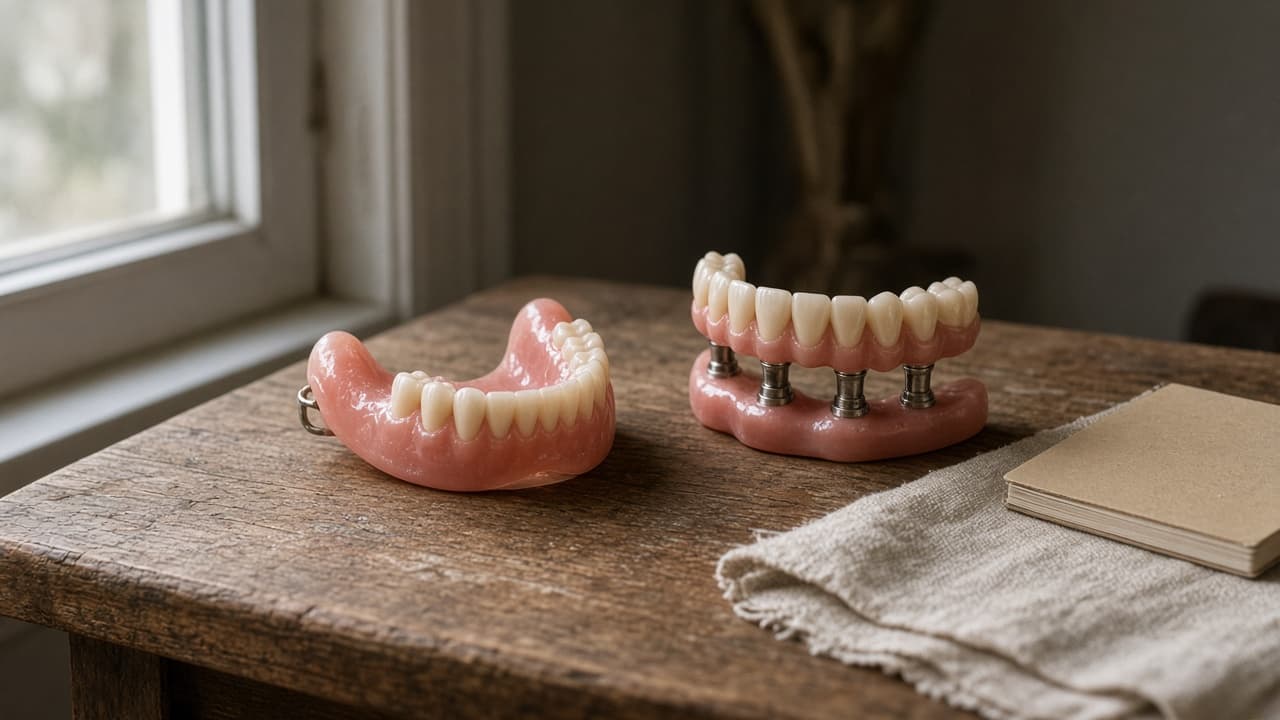
Dentures sit on your gums and come out; dental implants are anchored in your jawbone and stay put. That one difference drives almost everything else — how well you can chew, whether your teeth move when you talk, and what happens to your jawbone over time. Many denture wearers don't have to choose between the two: implants can also hold a denture firmly in place.
| Comparison category | Conventional dentures | Snap-on (implant-retained) dentures | Fixed implant bridge (e.g., All-on-4) |
|---|---|---|---|
| Held by | Suction and adhesive | Clips onto 2 to 4 implants | Screwed onto 4 or more implants |
| Removable? | Yes, daily | Yes, for cleaning | No — only your dental team removes it |
| Movement when eating | Can shift or lift | Much more stable | Stable like natural teeth |
| Jawbone | Continues to shrink | Implants help preserve bone | Implants help preserve bone |
| CDCP | Covered | Overdentures covered with preauthorization | Generally not covered |
Not sure which option fits your mouth? Nine questions, no obligation, and a personalized next step.
Find your best option in 2 minutesWhy do people look beyond dentures?
Because dentures can move. Some people have trouble chewing certain foods because their dentures shift in the mouth. Others worry about them lifting while speaking or laughing. And because a denture rests on the gums, the bone underneath keeps shrinking, so dentures tend to loosen over time and need relines.
What makes dental implants different?
An implant is a titanium post placed in the jawbone that acts like a tooth root. Replacement teeth attach to the implants, so they don't rely on suction or adhesive. Because chewing forces reach the bone through the implants, they also help preserve the jawbone that dentures can't. What years without teeth do to that bone is in dental implants with bone loss.
- estimated 10-year survival of modern dental implants
- 96.4%

Are dental implants comfortable?
Once the mouth has healed, most patients say implants look and feel like natural teeth. Because they are fixed in place, they don't rub or slip while eating or talking. Some soreness or swelling right after surgery is normal and usually settles within days.
Are dentures the only choice for missing teeth?
No. There are several options, and the right one depends on your oral health, bone support, lifestyle, and budget. A dental professional checks all of these before recommending implants, which is why we start with a free consultation and a 3D scan.

How do you care for dental implants?
Brush, clean around the implants, and keep your regular check-ups. Implants can last a long time with good home care. Your team will show you how to clean under a fixed bridge or around snap-on attachments.
Why Renew for denture alternatives?
Tom Szarski has spent over 20 years as a denturist in Ottawa, so we understand dentures as well as implants. At Renew, the implant surgeon, the denturist, and the onsite lab plan your teeth together, whether that's a snap-on denture or a fixed full arch.
A closer comparison of a denture that clips onto implants and a fixed arch is snap-on dentures versus All-on-4. What the Canadian Dental Care Plan pays, and what it leaves out, is in does the Canadian Dental Care Plan cover dental implants. The service page for a stable denture is denture alternative.
Sources
- Howe MS, Keys W, Richards D. Long-term (10-year) dental implant survival: a systematic review and sensitivity meta-analysis. J Dent. 2019 (96.4% 10-year implant survival)
- Tan WL, et al. A systematic review of post-extractional alveolar hard and soft tissue dimensional changes in humans. Clin Oral Implants Res. 2012 (bone loss after tooth loss)
- Government of Canada. What services are covered in the Canadian Dental Care Plan (dentures and overdentures coverage)
Frequently asked questions
Are dental implants better than dentures?
Implants are more stable and help preserve the jawbone, while conventional dentures are removable and rest on the gums. Which is better depends on your bone, gum health, budget, and preferences. Many denture wearers choose a middle path, such as snap-on dentures held by implants.
Can I switch from dentures to implants?
Yes. Many of our patients have worn dentures for years before switching. A 3D scan shows how much bone you have and whether angled implants, like All-on-4, can avoid grafting.
Does the Canadian Dental Care Plan cover implants?
CDCP covers complete and partial dentures and, with preauthorization, overdentures. It does not list most implant treatment as covered. Our team checks exactly what applies to you and explains your options at the consultation.
Do dental implants hurt?
Most people feel some soreness and swelling for a few days after surgery, which usually improves as the mouth heals. Sedation options are available if you're nervous.